

Finding Our Identity in Geek Culture
The Mirror Box staff talk about how they identify as geeks (or nerds, dweebs, dorks) in their own unique ways!
ALEX OAKLEY:
In what movie did you first see yourself reflected on screen?
I first saw myself in the character of Timone in The Lion King. I wanted so badly to be a snarky, sarcastic know-it-all. But as I've grown I realized I would much rather be Pumba. Fat, happy, and farting in public.
What creators do you most identify with?
I definitely identify with the band OK Go. They use their platform as a band to blur the lines between music and visual art and spectacle, as well as utilizing it as an educational platform, in ways that few modern bands match. In addition, I'm very fond of internet personality Thomas "Tomska" Ridgewell, as I relate a lot to his struggles with depression, weight gain, and personal growth.
What movie (or other piece of art) most opened you up to a new culture or point of view?
For whatever reason, the movie Holy Motors has left an impact on me no other movie has ever managed to. Its close relation to French Surrealist cinema was one of my earliest exposures to truly non-traditional narratives, and really helped sparked my interest in Film Theory.
When playing a video game or role-playing game, do you play as someone just like yourself or someone completely different? Why?
I definitely use Role-Playing, like DnD, as a way to escape and tell stories. I err more on the side of making interesting narratives with the characters I select. Unless it’s Telltale's The Walking Dead, in which case I must protect Clementine at all costs.
Who's your go-to Mario Kart character?
Dry Bones. Every time. Love that little skeletal friend.
Define yourself using a line from a movie:
"I have a plan to go mad." - Mr. Oscar in Leos Carax's Holy Motors
"Life is a gamble, at terrible odds. If it were a bet you wouldn't take it." - Rosencrantz or Guildenstern in Stoppard's Rosencrantz and Guildenstern are Dead
COLBY MCHUGH:
In what movie did you first see yourself reflected on screen?
The Goonies, because I was a suburban white kid who loved adventures and hanging with my friends, and I had an athletic and cool older brother who I constantly fought with.
What creators do you most identify with?
Stephen King and Brian K. Vaughn. King is obvious, but Vaughn is my all time favorite comic book writer, with some of his best work being Y: The Last Man and Saga. Also Mark Duplass. I think we’d be friends.
What movie (or other piece of art) most opened you up to a new culture or point of view?
Not a specific piece of art, but a genre. I started listening to K-Pop last year because it was great music to exercise to, but I'm a little ashamed to admit that I've grown to love it. Let's be honest though, it's not even a guilty pleasure at this point. It really opened me up to a whole world I never would have found in a million years, and I’m very grateful for that.
When playing a video game or role-playing game, do you play as someone just like yourself or someone completely different? Why?
I like to play someone totally different! What's the point of fantasy if it isn't just a little escapist, right?
Who's your go-to Mario Kart character?
Luigi, because he is a perfect angel of a character and anyone who says anything different is my enemy.
Define yourself using a line from a movie:
"You are one pathetic loser … no offense" - Lloyd Christmas, Dumb and Dumber
JACOB YORK:
In what movie did you first see yourself reflected on screen?
Listen. I'm a straight, white male. It's the honest to God truth that I've never had a moment where the concept of "identity" really resonated with me "for the first time". That said, there are all sorts of problematic dummies who took great pride in their taste in music that I've probably compared myself to before.
What creators do you most identify with?
We're going off the board a bit with music, but Big Data and Jens Lekman hit tones of my personality that I didn't know were there until I heard their songs.
What movie (or other piece of art) most opened you up to a new culture or point of view?
Bamboozled and Hedwig and the Angry Inch. I watched them both in high school and they completely rearranged my perspectives on a great many things. To this day, Hedwig is the thing I watch if I'm down in the dumps and can't seem to get out. I'd watch Bamboozled a lot more but it's not available for streaming and I've lost the DVD in multiple moves. Put that baby on Criterion, please.
When playing a video game or role-playing game, do you play as someone just like yourself or someone completely different? Why?
Like me, more often than not. I like to be good boys. I frankly have trouble playing as "evil" characters. It just doesn't feel right to me. I want that "Good" ending.
Who's your go-to Mario Kart character?
Yoshi. Also my go-to Smash brothers character.
Define yourself using a line from a movie:
It does not define me, but there's one that immediately popped in my head:
"Amsterdam ... I'm New York ... don't you never come in here empty handed again, you gotta pay for the pleasure of my company." - Bill the Butcher, Gangs of New York
MONICA BEARD:
In what movie did you first see yourself reflected on screen?
Lilo and Stich! I too was a weird little girl who lived in her head.
What creators do you most identify with?
I feel like I'm still a little early in my journey to know that answer to that. I guess anyone just starting out, learning how to create in a way that serves yourself and your purpose.
What movie (or other piece of art) most opened you up to a new culture or point of view?
I remember really loving the depictions of chinese culture in Mulan.
When playing a video game or role-playing game, do you play as someone just like yourself or someone completely different? Why?
Someone just like myself! I think it's because I trust my own judgement too much to choose other options. That is, I always think I know the best way to get things done.
Who's your go-to Mario Kart character?
Princess Peach!
Define yourself using a line from a movie:
“Be careful of mankind. They do not deserve you.” — Wonder Woman
CK LOVE:
In what movie did you first see yourself reflected on screen?
The truth is - I never saw myself REALLY in films, sure I felt like Betty Blue when I felt vulnerable and lovesick. Sure I felt like Marianne Faithful in Naked Under Leather when I wanted to express a spirit when I was sick of the societal introjects about women and sexuality and sure, who wouldn't like to kick Harrison Ford's ass because he treated Carrie Fisher like shit. But I never saw myself wholly and fully in film because I do not identify with the woman who is constantly the one waiting for the man to come home. Or being a mom. Or being the ball buster boss of the eighties/nineties movies. I did not see myself reflected because I wasn't. Really. Only recently, are we seeing woman protagonists in film and better ones when we write them.
What creators do you most identify with?
I love it when people follow their inner voice; the art has an emotionality that seems strangely moving in its simplicity. Creators who understand that art is a construct that need not exist in the real world, like David Lynch, Giacometti (sculpture), Yoko Ono.
What movie (or other piece of art) most opened you up to a new culture or point of view?
I will say style of art: Modernism in art, film and architecture.
When playing a video game or role-playing game, do you play as someone just like yourself or someone completely different? Why?
Someone completely different so I can express sides of myself not yet discovered because it's fun.
Who's your go-to Mario Kart character?
Princess Peach. Of course!
Define yourself using a line from a movie:
"Only love can save this world. So I stay, I fight and I give. This is my mission now. Forever." - Diana Prince, Wonder Woman
SONYA MAY:
In what movie did you first see yourself reflected on screen?
Mulan. She was the first kick-butt female character who embodied the strength that I wanted to have as I grew up, plus she was one of the first Asian characters I ever saw on screen.
What creators do you most identify with?
Mindy Kaling and Greg Pak
What movie (or other piece of art) most opened you up to a new culture or point of view?
Snowpiercer came out right as I was leaving home and entering college, and honestly, it's a film that's stuck with me ever since because it displays class struggles and corruption in such a timeless manner. Even though it is set in the future, it touched upon so many relevant issues such as climate change, class structure, and morality. Snowpiercer had me thinking about humanity and our world in different ways than I was taught to while growing up and I love it for that.
When playing a video game or role-playing game, do you play as someone just like yourself or someone completely different? Why?
It depends on the game. For instance, in the Elder Scrolls games I always play as a dark elf, which started simply because I thought they looked cooler, but continued because I liked the special abilities that came with their race. But then in Star Wars Knights of the Old Republic, I always made my character look as close to me as possible, because I wanted to see myself as a Jedi. Either way, I do try to match characteristics to myself as much as possible so that I can still feel like the character is me.
Who's your go-to Mario Kart character?
I'm much more of a Super Smash Bros. kind of gal, and Samus Aran is my go to for that
Define yourself using a line from a movie:
"I'm letting life hit me until it gets tired. Then I'll hit back. It's a classic rope-a-dope." - La La Land
JORDAN NOEL:
In what movie did you first see yourself reflected on screen?
This is gonna sound real weird and it’s not something that I have any real understanding of, but it's Vincent Gallo’s character, Billy Brown, in Buffalo ’66. (Yes, I’m quite uncomfortable with this answer.)
What creators do you most identify with?
I don’t know that it’s exactly that I identify with them but Werner Herzog, Lina Wertmüller, and Andrzej Zulawski all have a mysteriously profound way of speaking directly to the core of my self.
What movie (or other piece of art) most opened you up to a new culture or point of view?
First thought is not actually/exactly new culture or pov BUT an acutely deepened understanding/ empathy/love for men spending their lives in prison and what loving masculinity can look like. It’s a ridiculously powerful documentary from 2017 called The Work.
When playing a video game or role-playing game, do you play as someone just like yourself or someone completely different? Why?
Completely different! I’m endlessly fascinated with the range of who we are and what we do and what potential we have to be someone completely different. Also, a fervent pursuit of varied experience.
Who's your go-to Mario Kart character?
Princess, duh.
Define yourself using a line from a movie:
“But everyone must believe that it isn’t the trick of an untalented artist, impotent artist. Not at all. It must look like a sure decision. Fearless, lofty, and almost arrogant. Nobody must know that a sign succeeds by chance … is fragile.” - Pietro, the son, Pier Paolo Pasolini’s TEOREMA
SARAH OKERSON:
In what movie did you first see yourself reflected on screen?
Dorothy from The Wizard of Oz. I loved her positive outlook on life, and how she got thrown into this crazy adventure and just threw herself into the experience.
What creators do you most identify with?
Greta Gerwig, Justin Baldoni, Gina Rodriguez, Reese Witherspoon
What movie (or other piece of art) most opened you up to a new culture or point of view?
Captain Fantastic. This film really opened my eyes to living a unique lifestyle filled with transparency and a lack of technology. This film showed both the benefits and downfalls of those choices, and I found those really fascinating.
When playing a video game or role-playing game, do you play as someone just like yourself or someone completely different? Why?
I typically choose someone who’s like me, but with amplified bravery. I’ve always wanted to be the strong, brave leader.
Who's your go-to Mario Kart character?
Mario or Princess Peach.
Define yourself using a line from a movie:
“To see the world, things dangerous to come to, to see behind walls, to draw closer, to find each other, and to feel. That is the purpose of life.” - The Secret Life of Walter Mitty
HUDSON PHILLIPS:
In what movie did you first see yourself reflected on screen?
Pump Up the Volume.
What creators do you most identify with?
M. Night Shyamalan, J.J. Abrams, The Wachowskis, Britt Marling, Mark Duplass.
What movie (or other piece of art) most opened you up to a new culture or point of view?
Cloud Atlas was probably the one that was most impactful recently. Not so much new culture, but definitely got my brain going in new directions for sure.
When playing a video game or role-playing game, do you play as someone just like yourself or someone completely different? Why?
Definitely a cooler version of myself, preferably with a bow and arrow. I basically play as who I wanted to grow up to be when I was a kid.
Who's your go-to Mario Kart character?
Luigi.
Define yourself using a line from a movie:
“Hey, I don't have all the answers. In life, to be honest, I've failed as much as I've succeeded. But I love my wife. I love my life. And I wish you my kind of successes.” - Dicky Fox, Jerry Maguire

Identity in Professional Wrestling (or Throwing Our Hearts Through Barbershop Windows)
Jacob York writes of his lifelong love of professional wrestling and the identity crisis that wrestlers have dealt with as the fans have continued to grow with them throughout the years.
Listen. I know you’re probably not here to read about professional wrestling. I get it. But this month’s theme is Identity and there’s no art form where identity is more inextricable from the art itself.
When I was young, I became a fan of professional wrestling because of the larger than life characters. I watched with rapt attention when Jake “The Snake” Roberts’ deadly cobra bit the arm of a prone “Macho Man” Randy Savage, blood dripping from the bite marks. I wrote letters to a hospitalized Hulk Hogan after a savage attack by Earthquake put him in the hospital. I’m a grown man and I still can’t fully forgive “The Heartbreak Kid” Shawn Michaels for throwing his tag team partner, Marty Jannetty, through a barber shop window/interview set. It’s easy (and not particularly new) to look at them as broad morality plays speaking to the lowest common denominator and, while I would argue that is reductive and condescending, I have to admit I see some points.
Once upon a time, the wrestlers’ personal identities were inconsequential. No one cared whether “The Million Dollar Man” Ted Dibiase was a nice guy or not “in real life”; wrestling purported to be real life. When he was in public, he was expected to be a nasty rich guy, due to the strictures of kayfabe (the idea of professional wrestling being presented as a legitimate competition … essentially “faking the marks”). Vince McMahon gave him a per diem to be spent in flashy ways while on the road. Tip big, but be a jerk about it. His personal identity was completely subsumed by his character’s.
Then … something changed. When the era of Kayfabe ended, things shifted for wrestlers and fans both. It started with a trickle. Good guys and bad guys being caught riding together. People who had no reason to like each other hugging in the ring. So called “dirt sheets” began to report on the backstage machinations with the same breathlessness of the Hollywood Reporter discussing future film deals. Slowly but surely, fans got “smart”.
“Stone Cold” Steve Austin is a fictional character. Kenny Omega is a fictional character. Kevin Owens is a fictional character. Yet Steve Williams, Tyson Smith, and Kevin Steen all exist in the real world and, in one way or another, the highs and lows of their lives have all been mined for storyline purposes. Professional wrestling is always looking at different ways to tell you stories. If it can mine Kevin Steen’s friendship with best friend Rami Sebei to deepen the story of Kevin Owens and Sami Zayn, it will. Blurring the lines of Kenny Omega’s real (?) romantic relationship with fellow wrestler Kota Ibushi allows us to experience “will they/won’t they” tension tinged with the spice of actual, legitimate chemistry and sexual tension. Steve Williams broke his neck in the ring; Stone Cold was never the same.
In the wonderful video essay by Super Eyepatch Wolf, he talks about The Undertaker and how professional wrestling is the only fictional enterprise where the characters age at the same rate as the audience. There are no “Six months later” jumps; we watch it all in real time. Even with a character as ridiculous as The Undertaker, an undead, old-west warlock, the person who plays the character still ages, becoming more mortal each day. The mortality is what keeps us showing up. Effy, an independent wrestler based out of Florida, is just as relatable as a barrier breaking gay icon as he is as a meat shell for the demon he sold his soul to for access to unbound pleasure. We all contain multitudes, you know?
Our humanity informs our creativity. Every new work demands we reveal more of ourselves to the audience, but exposure without creativity is just vanity. In the search to make our work more intimate and more personal, we would do well to see what lessons we can take from every art form under the sun. Identity in professional wrestling is nuanced, complicated, and all the sweeter for it.

The Satisfying Self-Reflection of The Bourne Identity
CK Love examines the parallels between her own life and that of The Bourne Identity and the way the film can be used to define character and identity.
Even if we wanted to, we can never really forget who we are, our innate selves. However, there is a chance to forget the person that people think we are, or make us out to be.
We are told constantly in our formative years what we are, and we formulate that in our own minds, to be who we are. This can manifest in self-doubt and leave you with an uneasy feeling of vertigo almost without a firm footing in the knowledge of who you are.
Things that were drilled into you when you were growing up can have a detrimental effect on how you see yourself and therefore respond in this world. Who wants to go around with the notion that “you’re a dumbass,” or “you can do no wrong,” or “girls are always nice,” etc? Shedding them is a must.
I changed with the help of my meditation. The beauty of a meditation practice in the traditional sense – without the new age frills – is that it is exactly about ridding yourself of all that you were told about who you are.
Most of us, especially artists, fear shedding the things we think make us artists; it’s like that whole idea about the 70s rockers who stopped taking drugs and feared that they would not be able to create afterward.
I thought after my intensive meditation stint that I would not be able to create anymore. But not true. I became a better writer, because my thoughts became clearer and more organized. The less confused about who I was, the clearer my thoughts and writing became. I wasn’t so hard on myself, which helped the words flow more easily.
Imagine, like Jason Bourne, you know nothing of yourself. You know nothing of your past or even your future. You know only your present. In the film, he first tries to think, Who am I? But nothing comes. Then he is forced to react. Ah ha!
The way he responds to outer stimuli starts to tell him a lot about himself. Jason didn’t have the knee-jerk reaction that comes from remembering what someone else told him who he was. His trained and resourceful self came through and he was effective in facing every obstacle he came across.
As far as I can tell, identity is fluid. It shifts. A lot of it depends on what we are obsessed with at that moment, who we are hanging with, or what job we have. Identity becomes something other than “who we are.”
In the case of The Bourne Identity, we see this when Bourne realizes that he and other agents have been programmed to be killing machines – and expendable. At one point, he says he doesn’t like who he is. But what people who meet him in the present respond to is not the killer, but the man who spared another man surrounded by children at his own expense. His intuitive innate self began to surface.
Which is his identity then, the killer or the man with a conscience?
All this told me that when you don’t have the conditioning elements anymore, you are free to discover parts of yourself that haven’t been seen. Our identity shifts because motives change, conscience rises, and/or circumstances require adjustments.
Watching The Bourne Identity, a few things became evident to me about not only how we define ourselves, but also how we define the characters we write.
Here are my top 4 ways to define characters the Bourne Identity way:
Through their action. This is not reaction or reflex, it is the action that comes from a combination of ability and intuition, the innate feeling of how you respond to situations as yourself and not what others say you are. At the end of the film, Bourne is about acceptance of where he’s been and who he expresses himself to be naturally. This is conscious action.
Through their reaction - caught off guard, knee-jerk, unconscious movement/response. I loved the moment when Jason grabs the baton of the Zurich police officer and realizes that he has lightening speed reaction time. His surprise and realization of what he is able to do without thinking was fun to watch. He was equally surprised during the assassination attempt shown in flashback that he had a soft spot for children to show a vulnerable side told a lot about not only the man himself, but it also revealed a lot about the “program,” its nefarious goals and the people who run it.
Through their abilities. Talents, idiosyncrasies, expertise, natural talent. His ability to react with lightning speed, have the knowledge no matter how buried to assess a given situation and people, his ability to memorize, shoot with pinpoint accuracy, all told us that he was well-trained through the “program”.
Through the reactions of others. Those that first meet Bourne, those that already know him, or those that are after him, the character relationships are based on the concept of asset vs liability. We have heard the adage, “the antagonist believes that they are the hero of the story.” It is important to illustrate this through relationships with others. It is easy to see Conklin’s (Chris Cooper) identity as ruthless, determined, protective and commanding, but what makes him come to life is how he navigates around his people. It’s a little one sided at first – he starts our ticking clock, he is ruthless. As the movie goes on, we can see his relationships begin to strain because he is “identified” with the success of the program and would do anything to do it. In the end, I suppose you can say karma got him.
I’ve always liked The Bourne Identity because of how it used this to its advantage. I miss movies like this where characters are extremely aware of themselves without becoming neurotic, and have the capacity to shed light on the fluidity of identity which brings the story to an end in a satisfying way.

How To Start A Writer's Group with Pepper Reed
Pepper Reed gives insight on the writing groups she’s currently a part of, what she loves about them, and even how to go out there are start your own!
I first met Pepper Reed through the online screenwriting group I run, ScriptBlast, and was quickly inspired by Pepper’s focused productivity. She let me in on the secret that a big part of her consistency is due to the fact that she’s part of not one, but two writing groups who inspire her and hold her accountable. I’m a big believer in community and these kinds of groups should be a requirement for every writer. If for no other reason, then for the power of knowing YOU’RE NOT ALONE. I thought it’d be a great idea to chat with Pepper all about HOW TO START YOUR OWN WRITER’S GROUP.
Tell us about your writing journey and the writer's groups you're involved in right now.
I started writing my first script in college. It was never finished, but there are still things in it that I come back to. I was an actor then. Later I wrote a short that turned into my first feature after I left LA and moved back to Oklahoma.
I stopped writing for a while. I was trying to figure out how to get into the industry and move towards my goals. I started script supervising for indie films and shorts. That’s when I really started writing. By the time I moved back to LA last February, I had drafts in various stages for seven features, two shorts, and a pilot already written. I’d also written the script for a music video I directed. I had a couple of people who would read my work and give me notes, but part of the point of moving was to kick everything into high gear.
I’m currently in two writers groups. The first one I started about two months after I moved to Los Angeles last year. The second one I just joined a month ago. Both groups are all women. With the first group, that was just how things worked out. I had posted in several groups (on Facebook and Google) that I’m a part of looking for a group to join and couldn’t find one that worked the way I wanted it to, so I created my own. Then I posted in the same places asking if anyone wanted to join. It ended up that only women responded.
The second group was organized by a local women’s tv writers organization in LA. They help women who want to write for TV. This group is interesting because we all write genre pieces, i.e. Sci-Fi or Fantasy.
I usually have a several scripts going at once. Currently, I have my spec. I just finished revisions based on notes from both of my groups and so it is basically done, but I might add a snarky line of dialogue or two before I submit it. I have a short which is going to be shot in March, so it is done, but then an actor might give me a comment, so it could have a change. I have a pilot that has been to one writers group but not the other. It’ll go out later this week and I’ll have a rewrite after that. I have another pilot idea that I’m thinking on and will write once I’ve submitted the other to the fellowships. Finally, I have a feature which has had two full drafts, but needs a good rewrite. It has been marinating on the back burner for a few months and is about ready for me to stir things up as soon as these fellowship applications are done.
Some people don’t work this way, and I can completely understand. For me though, it helps. One day I can work on my spec, then next my feature. And if I’m blocked or having trouble with one project, I can move over to another one for a little while and take the pressure off.
Why is it important to you to be a part of a group?
I wanted a writers group so I was getting notes from people who worked in the industry. Reading scripts regularly and learning how to give and receive notes is incredibly important. Plus there is the added benefit of having built in deadlines. With my first group, we know well in advance when our turn is coming up.
How do they work? How often do you meet? What's an average group like?
I was surprised that I had to create a group myself. I wanted a group that would meet once or twice a month and we would read one of the members’ entire script in advance of the meeting and give notes at the meeting. Most of the groups I found in LA, you would bring in 5 to 10 pages and people would read them right then and give notes. I didn’t find that helpful. If you need accountability to make sure you do your work, yes, but I don’t have that issue.
Both of my groups meet every other week, one on Mondays and one on Thursdays. We send our scripts to the group a week in advance to give everyone plenty of time to read them and make notes. We talk about what we’re working on, exciting meetings, events we are going to, finding scripts for episodes of shows we want to spec. A lot of the talk at the moment is about the TV writing fellowships. We give our notes to the person whose script is up and then, if they have questions, they ask those.
What's the biggest benefit you've personally gotten out of the groups?
This industry is really about relationships, but a lot of writers are introverts. It’s much easier to get to know people when you are in a smaller group (some of those networking events are insane) and you have a built in topic of conversation. I’ve made some really good friends, which can really be a challenge, especially in a city like LA.
You're part of an all women's writers group and an all genre (sci-fi/fantasy/horror) writers group. Do you find a deeper connection in these kinds of like-minded groups?
My Sci-Fi/Fantasy group got references and Easter eggs that I’d written into my Lucifer spec, which my other group didn’t get, but I get great notes in both. And since both groups are all women, I think they can push me to go deeper. I know that their comments are coming from their own experiences as women.
I write for the girl that I was growing up. When I was young I didn’t feel like I fit in anywhere. I was an outsider. But I connected with characters in the books I read and in the films and tv show I watched. Now, I use paranormal and fantasy characters as a metaphor for “the other.” If you can connect with a vampire, if you can empathize with a werewolf, maybe that can help you understand your neighbor who doesn’t quite fit in. Having a group that understands and enjoys these metaphors can be helpful when they might read a script multiple times, since my Sci-Fi/Fantasy group is about half the size as my original writers group.
What is it about genre film & tv that draws you to it?
I love being able to see inside people minds. Film and television are visual adaptations of imagination. We are painting the screen with light and color, in some cases, ideas that were originally imagined hundreds of years ago.
What tips do you give for starting and/or running a successful writers group?
Make sure that the people who are joining want the same kind of group you want. When I was first looking, I had posted a very clear “ad” but people kept coming back to me saying they were interested but would then describe a group like all the ones I didn’t want.
I’ve met with most of the members individually as well as with the group, just to get coffee and chat. When I started my first group, I knew one of the women and had met one of the others. Everyone else was a complete stranger. We meet at my apartment most of the time now, but in the beginning we met in a public space.
As for keeping it going, my first group made it through a summer break and a winter hiatus for the holidays. I’d say be very specific about when you’re taking the break and for exactly how long. Know in advance who is up when you get back, otherwise, things will fall apart.
You can follow along with Pepper’s writing journey on Instagram at @pepperreed .

Velvet Goldmine: The Search (And Destroy) for Identity in Film
Jordan Noel examines his obsession with the short-lived genre of Glam Rock and how Todd Hayne’s Velvet Goldmine influenced his own personal life and direction.
As a young man I was completely obsessed with a short-lived rock’n’roll phenomenon from the early 70s, one that somewhat inexplicably morphed and mutated into the Hair Metal of the 80s. It was called Glam Rock … it wasn’t just David Bowie, Iggy Pop, T Rex, Roxy Music, and Lou Reed … it was Silverhead and Eno and Jobriath and Gary Glitter. It was boys in women’s clothes and makeup, everything shiny and dangerous, elaborate and alien.
I came up in the 90s hardcore punk scene, a scene with no shortage of bold masculinity. Big pants, big shirts, big statements were the go-to straightedge aesthetic—so when my roulette of rebellion began spinning again to find my next musical obsession it was Glam I landed on. What a world I had found … with so much to explore.
It was 1998 and the universe seemed to be trying to tell me something. I wouldn’t discover it until it hit the video store shelves, a cut-up collage homage to the Glam era shining on the silver screen: Todd Haynes’ celebratory Velvet Goldmine. On paper I should passionately hate this movie—it takes music I love, that has great personal meaning to me, and has actors recreating it, and mixing it all up … but Todd Haynes is a masterful filmmaker, and Velvet Goldmine is a fawning love letter rather than an opportunist exploitation. Haynes’ deep appreciation and passion for the subject is clearly evident. It’s often described as more of a painting than a movie—I agree, painted in a glorious palette of glitter and sparkle and all the necessary dirt.
Much of the movie (and Glam in general) is about sexual liberation and exploration. As a young dude brought up in the sexually repressive environment of 80s taboo-wary evangelicalism, this was just the kind of danger I was looking for. But it wasn’t about the act of sex; I was still years away from that. It was about identity and role reversals and culture. I was 15 when I bought my first pair of women’s pants. I wore a silver sequin tailed tuxedo with homemade sparkling platform shoes and hot pink star-shaped glasses to my senior prom. Then I grew my hair out, dressed in all kinds of women’s clothes, studied fashion design, regularly went to drag shows, and carried a pink nylon purse. Some friends and I were physically threatened by some good ole boys (actually full grown country men) at a county fair after a male friend of mine kissed me in the line for the whirligig—it was absolutely terrifying but also oddly exhilarating. True Glam had expired a quarter century before but I wanted to bring that spirit back. I wanted to find myself in it. I spent many nights in my freshman dorm working on my GeoCities website: proudly coined Neo-Glam. It was a manifesto of style and substance. Luckily, no trace of it can be found today. I still worshipped the original glam music, but also pushed a then-current British Glam movement—bands like Pulp and The London Suede.
I quit college to pursue a life of Rock’n’Roll and tart myself up as much as I could get away with, deeply influenced by another band briefly brushed into the Velvet Goldmine cyclorama, The New York Dolls. This sort of thing went on well into my 20s. The experimentation, the fight against norms, and the partying, the decadence, the pursuit of the Rock’n’Roll dream, and in it, meaning, identity, purpose. A mission to change the world. Much like Ewan McGregor’s character (a gay mashup of Lou Reed and Iggy Pop named Curt Wild) says near the end of the film: “We set out to change the world, ended up just changing ourselves … What’s wrong with that? … Nothing, if you don’t look at the world.” Wide-eyed, life’s possibilities and scope appeared without limit. I could change myself, make myself, and set fire to the world at the same time. While my vision may have been a bit overblown, it’s a come-of-age I won’t regret. Velvet Goldmine personifies this experience for me. Admittedly a romantic nostalgia for an era gone before I even existed, it still provided a shimmering path through the shadowy sides of adolescence.
So, to address the elephant in the room, yes, Velvet Goldmine is very much about gay culture, gay identity, homosexuality, and bisexuality. Much of it kicked off in a scene where Brian Slade, the glam superstar in the film, comes out at a press conference, much like David Bowie in interviews with both Melody Maker and Playboy at the time. Am I gay? Or was I in my early 20s? The short answer is no … but at the time I really didn’t know what it would feel like to be gay, or bi-sexual. I knew I loved the culture and the product, and a part of me really wanted to discover that I was gay. Finally, an identity other than just ‘weirdo’. A cause to get behind, to defend. Alas, despite my beliefs of sexual fluidity and spectrum, I wasn’t actually gay. But that didn’t change my love for Glam and no film has ever come as close to portraying that love than Velvet Goldmine. Well, maybe DA Pennebaker’s Ziggy Stardust & the Spiders from Mars, but that’s another story for another day.

Kevin O'Brien on How He Captured an Authentic Voice between Faith and the LGBTQ Community in At the End of the Day
We interview writer/director Kevin O’Brien about his film At the End of the Day and how he found his own creative identity through amplifying a voice that is so rarely heard in such an honest and empathetic way.
I had the privilege of meeting Kevin O’Brien at the Oxford Film Festival while we were screening This World Alone. Kevin’s film At the End of the Day pulls off the impossible: an honest film at the intersection of faith and the LGBTQ movement, a rare dramedy that moves you to tears with its authenticity. I sat down to talk with Kevin about how he found his own identity through this unique story and found a large audience who identifies with it as well.

Kevin, tell us a little about At the End of the Day and how it all came together.
At the End of the Day is a dramatic comedy that explores the tension between the church and the LGBTQ community, specifically focusing on LGBTQ youth facing religious rejection. We follow Dave, a conservative, Christian professor who experiences a profound change when he finds himself planted in a queer support group to undermine their opening of an LGBTQ youth homeless shelter. While the movie is not subtle in its topic, from a wider perspective it deals with love, family, and what it looks like to discover your own truth. Most of us don't take the time to listen to or validate the lived experiences of others, and that's a thing that is dividing our relationships. I started writing the screenplay in 2014, spent a few years raising funds, we shot the film in January/February of 2017, and held our world premiere at the TCL Chinese Theatres at the Dances With Film Festival in June 2018. Now the film is out on DVD, BluRay, and Digital.
You're tackling some pretty heavy subject matter here, yet you choose what (on the surface at least) is a light-hearted genre to explore it. Why comedy/dramedy?
My first attempt to tell a story about this subject was much heavier, and a bit melodramatic. At some point I realized that a better way in would be through comedy, as comedy is a great disarming tool for storytelling. It was not a task I took lightly, covering such a deeply hurtful topic with a lighthearted tone, but I got a lot of feedback from my LGBTQ friends throughout the whole process. It was important to me that those who lived these experiences felt heard and represented. The drama, the heart-wrenching moments, were not hard to find, as there is still so much ignorance and fear in the world, especially within Christian institutions. The comedy was so important and nerve wracking, hoping to walk the tightrope.
At the End of the Day is a rarity in that it explores the cross-section of the LGBTQ world with the faith-based world. Was there a fear at any point that you thought, "There's no way either of these audiences will show up for this?"
I've had that fear from the beginning, yes. I've had some people ask me, "How are you going to make a film about faith and have gay people in it?" I've also had the question, "How are you going to make a gay film without sex in it?" My answer has always been, "Because there are queer people of faith, and there are a lot of aspects of life that don't involve sex." I knew the audience was very specific for this movie, and that's who I made it for. I certainly made the kind of movie I wanted to see, and I know there is a large underserved audience for it.
The film has one of the more authentic voices I've ever seen captured on screen, to the point that I was brought to tears a number of times. What's your personal experience with this world and how did you capture not only your own voice, but seemingly the voice of an entire generation who is longing to be heard?
Thank you for that - being authentic was truly my number one priority. I grew up as a straight, white, cisgender male in an evangelical church, so that part of the story I knew forward and backward. I was able to pull from a lifetime of relationships and experiences to write the characters who lived in that world. I did not, however, have any personal experiences within the queer community, so I knew I had a ton of studying to do. I am not a reader, but I know I read more books in the 6 months of writing than I did in the entirety of my life before. Not only did I read a ton, but I asked my queer friends and acquaintances about their personal stories. I asked a lot of questions, and I tried to capture the essence of their experience. While many of the lead characters are straight, I was intentional to make the actual heroes of the story to be the support group, the way they stuck together, and exemplified true love to Dave.
This is a subject matter that could easily come off as "preachy" (for lack of a better word). How did you navigate the difficult balance so well in your writing?
I am not sure how well I did that; I think it depends on who you ask. I did my best. I don't think there's a formula for it, it's more of a gut reaction, and I had to listen to my gut. That process was present all through the writing, through production, and certainly into editing. It even exists in the marketing of the film. It's a hard thing to do to not be preachy, when your film is decidedly calling out a theology that is dangerous and damaging to marginalized people. I am certain that people in stark opposition to the LGBTQ community will consider this preachy, but I didn't write it for them. I wrote it for those who have some empathy they can't explain toward the LGBTQ community. Those who grew up with a narrow world-view, and who, like me, are starting to feel a sense that something is not right with that. I also wrote it for those in the LGBTQ community who have faced religious rejection. I want their story to be heard. I want them to feel represented. And I want them to know they are whole just as they are.
What's the most powerful response you've gotten to the film so far?
I've had so many LGBTQ people who grew up in an evangelical church or attended a Christian school (either high school or college) who have thanked me in tears for telling their story. I've had people tell me that their conservative friends watched it and liked it okay, and a few days later their daughter came out. They still had so many questions, but because of the movie, their first reaction was, "We love you and will always love you." But the most powerful response was probably after the screening at the Orlando Film Festival, when 3 of the 4 youth who shared their real stories as part of the film, watched it for the first time and were honored to be part of it. That was a beautiful moment.
What advice would you give to a young filmmaker out there trying to find their own identity and voice in their work?
There is a quote from Elizabeth Gilbert that I have printed and framed in my office. I also have it as my phone's lock screen. It has been vital to my confidence and my ability to keep going: "Recognizing that people's reactions don't belong to you is the only sane way to create. If people enjoy what you've created, terrific. If people ignore what you've created, too bad. If people misunderstand what you've created, don't sweat it. And what if people absolutely hate what you've created? What if people attack you with savage vitriol, and insult your intelligence, and malign your motives, and drag your good name through the mud? Just smile sweetly and suggest - as politely as you possibly can - that they go make their own fucking art. Then stubbornly continue making yours.” - Elizabeth Gilbert, Big Magic
At the End of the Day is now available on Bluray, DVD, and digitally on iTunes, Amazon and Google Play.

Revisiting Schizopolis, Steven Soderbergh’s Weird, Wacky, And Only Starring Role
Colby McHugh geeks out over Steven Soderbergh’s experimental comedy and explores the director’s journey in finding (and redefining) his identity over and over and over and over and over again.
“In the event that you find certain sequences or ideas confusing, please bear in mind that this is your fault, not ours. You will need to see this picture again and again until you understand everything. In closing, I want to assure you that no expense was incurred bringing this motion picture to your theater. And now, filmed in its entirety, and proven to heal minor cuts and abrasions, we proudly present Schizopolis.”
That’s an excerpt taken straight from the opening monologue of Schizopolis, delivered by Soderbergh himself, to us (the metaphorical audience) from a stage in a literal auditorium. Frankly, this was not exactly how I expected this film to begin. I should say, even though I would certainly consider myself a fan of Steven Soderbergh’s work, I don’t think I was quite prepared for the mental onslaught that is Schizopolis, a film I watched based on a recommendation from my local video store (Shout out to Videodrome, Atlanta’s best). It was described to me as an experimental comedy that was not only written and directed by Soderbergh, but also featured him acting in the lead role. Color me intrigued.
So I rented it, expecting something closer to his other films that I’d seen and loved. I expected a tight script with some good humor and a driving story. What I got, however, was something totally different. This was a film that took most of the general rules of storytelling, and tossed them out the window. The crazy thing is, it worked. I loved it, and considering how successful Soderbergh has become in the last few decades, I found it really interesting that I’ve never met anyone else (outside of Videodrome) who’s seen Schizopolis.
So I figured it was worth a look again, and viewing this film through the lens of “Identity” really opens it up to a lot of interesting thoughts and dissections.
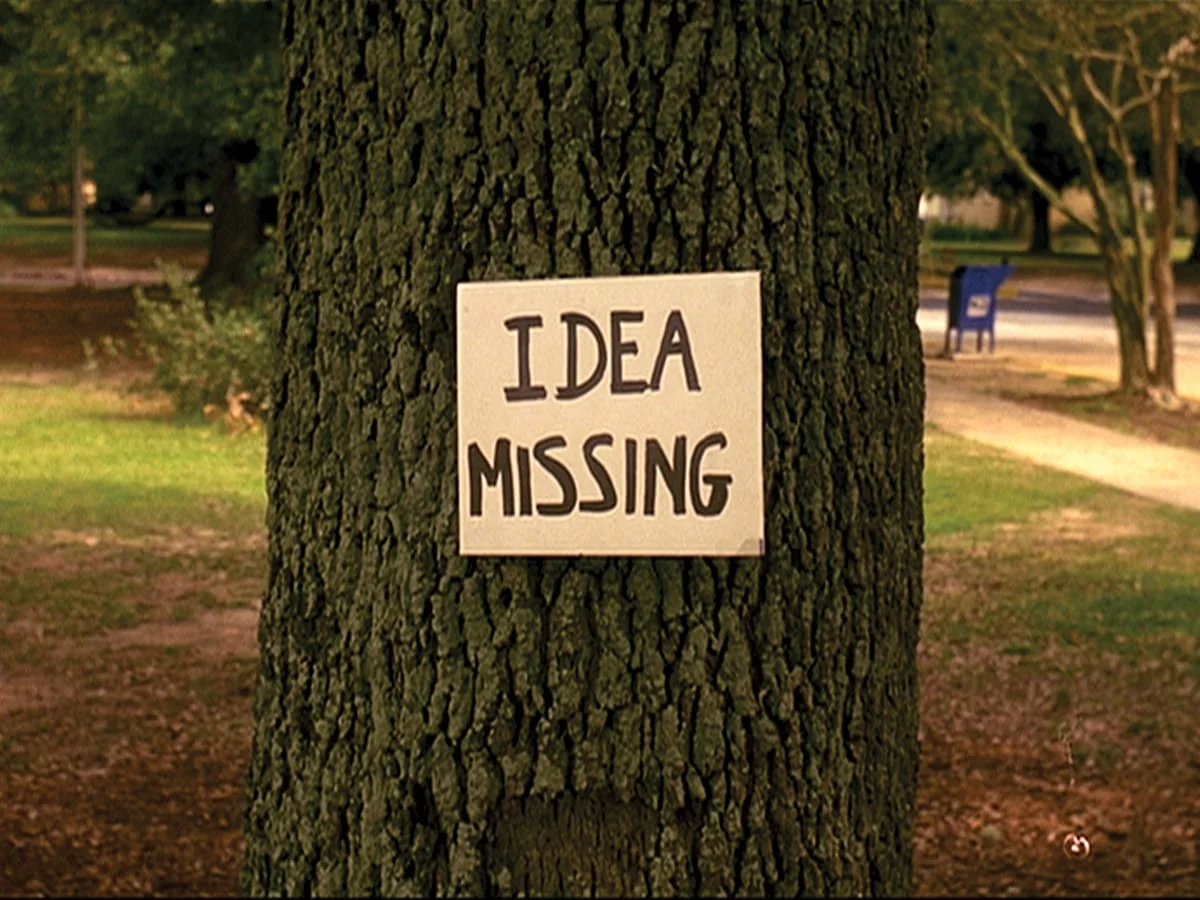
Without going too deep into the narrative of the film, for your own sake, Schizopolis follows Fletcher Munson (played by Soderbergh), a bored employee of a Scientology-esque self-help company. What follows is a mishmash of creative and weird vignettes that contain everything from slapstick humor to true postmodern strangeness. The narrative does have a through line, although it certainly takes some strange turns, with the strangest being a side story involving a man named Elmo Oxygen who speaks only in gibberish phrases. It’s a real sight to behold.
Munson eventually begins to follow a man who he believes looks just like him (and drives the exact same car). He peeks into the man’s home and realizes that the man is indeed him.
Normally, what happens next would infuriate me, but in a film like Schizopolis it somehow makes sense. Basically, Munson somehow assumes the identity of the other man, a dentist named Dr. Jeffrey Korchek (Soderbergh really does have a way with names), and becomes him. Not only is this the only film Soderbergh has ever acted in, but he plays two different characters in it! Well, sort of. It’s a bit hard to explain the logic behind Schizopolis, but that’s the point, right? A story in which a character just decides to assume the identity of an entirely separate character fits right in with every other weird thing that happens.
Side note: Reading film reviews from ’96 when the movie was released is a real treat. Nobody quite knew what to make of this weird film that was seemingly created out of nowhere, for nobody in particular.
It should also be said just how funny Steven Soderbergh is in this film. It really is crazy that he hasn’t acted more since this, because he very easily could have pivoted this into more roles, if he wanted to. But that’s the beauty of Soderbergh. He’s always been one of the most unpredictable directors Hollywood has ever seen.
Schizopolis is a story about identities, and I think if we take a look at the context surrounding the film itself, that’ll make it all the more interesting. Back in 1996, Soderbergh had just finished up a stretch of three consecutive films that failed to live up to the success of his groundbreaking debut, Sex, Lies, and Videotape. Not to say that those three films are bad, by any means. Just a little underwhelming, perhaps.
Either way, and this is total and complete conjecture, Schizopolis feels to me like a response to those three movies (Kafka, King of the Hill, and The Underneath, in case you were wondering). It feels like a creator stuck in between ideas and identities, so he created Schizopolis and allowed his brain to just kind of explode onto the screen.

I don’t think it’s surprising that Soderbergh wound up making Out of Sight just two years later, which put him on the Hollywood map, and would set him up perfectly to later direct the Ocean’s trilogy. From a creative perspective, Schizopolis feels like a response to a time of uncertainty in Soderbergh’s career, a film that allowed him to expand his storytelling outside of the norm. After he got Schizopolis out of his system, Soderbergh went on one of the all-time great movie tears, directing five straight hits that still stand up today (Out of Sight, The Limey, Erin Brockovich, Traffic, Ocean’s Eleven).
Part of what makes his career so interesting and unique is the fact that he doesn’t allow himself to become complacent. He continues to push the boundaries of filmmaking, although not quite to the extents of Schizopolis, but also not too far off. He’s “retired” multiple times, moved to television for a bit, directed two films on an iPhone, and even created an app with which to watch his latest HBO series. It’s almost as if he continues to create new identities for himself, while still remaining true to what makes him one of the most daring directors in Hollywood.
All I’m asking is that someone else watch Schizopolis, if only so I can talk about it more. I’m selfish.

Finding Your Creative Identity (VIDEO)
There is a lot of pressure to demonstrate your originality and many times leads to artificial projects made to please others. In this video, filmmaker Adam Petrey discusses ways to stay true to yourself and how to develop your own creative identity while living your life to the fullest.
One of the most important aspects of being an artist is self-discovery. The journey of finding out what you have to say about the world and how you're going to say it. There is a lot of pressure to demonstrate your originality and many times leads to artificial projects made to please others.
While filmmaking requires a great deal of self motivation we should never feel alone in the process. Always surround yourself with a community of people that lift you up and motivate you to do your best. In this video, we'll discuss ways to stay true to yourself and how to develop your own creative identity while living your life to the fullest.

Finish Line Script Competition Founder Jenny Frankfurt on Finding Your Voice
I think some writers are born with a way of writing. However, a lot can be done to try and create something that isn’t there to begin with. That’s reading, watching films and TV and really studying different genres…
As a screenwriter, the concept of IDENTITY is always first and foremost in my mind. In part because so much emphasis is put on “voice” as a way of standing out in the very large crowd, but also due to the fact that so many voices are underrepresented in Hollywood films. We’re beginning to see a shift towards more diversity on screen and behind it, but it often feels like a giant ship to get turned around.
We reached out to former literary manager Jenny Frankfurt to pick her brain about how to find your voice as a writer, how to encourage diversity as a filmmaker, and what motivated her to find her own identity through a career change.
Jenny transitioned from the roller coaster world of Hollywood lit management to running the Finish Line Script Competition, a screenwriting contest that not only offers real, legit access to Hollywood insiders for winners but also has the unique distinction of giving you notes on your script so you can re-write and re-enter to better up your chances of winning.

Tell us a little about how you first got into the film industry and why the screenplay world specifically?
I started ‘floating’ at William Morris in NYC, which means I was a permanent temp there. I worked with a lot of different agents and in many different departments and it was a great education, but my first assistant job was with the head of the Theater Department. At William Morris. In NYC! Wow. So, I learned a lot about writing, which I was already quite enthralled with, being an avid reader. And I learned that for this agent at least, that his playwright clients, in order to have plays produced, has to also make a living writing screenplays or working in TV. They all did and some of them are some of the biggest show runners around still. This allowed them to make a living while pursuing their writing dreams. He just didn’t want starving artists, so the commissions paid for the difficulty of putting up a play in NYC even though these are some of the the best playwrights around. Very smart business strategy. It’s longevity and the financial freedom to get the writing right.
What kind of stories are you drawn to and why?
I love dark pieces and character pieces. Equally I love to laugh and I love great action scenes. But I want emotion and theme to work together most of all. And to feel something while I’m reading.
You went from being a lit manager to running a screenplay contest. What was the biggest motivator for the change?
Burnout. 15+ years of management and I really wanted to feel control and have the freedom to take time and help writers get their work in its best shape. I love working with writers, directors, even actors! I still have a real sense of management when our winners are chosen and we take the next step in setting up meetings and getting their material to people other than the mentors in the competition. I’ve always had a strong sense of who will respond to specific material so I work a lot with quarter-finalist and semi-finalist scripts too and make sure people in the industry I think are a good fit for the genre/tone/writer are introduced to their work, whether they’ve won or not.
What makes Finish Line different and why did you set it up the way you did?
When I was a manager and then afterwards when I took some time off, I read a lot for competitions and for agencies and so on. I’d been doing that since I was about 19. Anyway, I would read scripts that people submitted for packaging at agencies or for big script competitions and they were just not there yet, but they were close! I thought, “This writer needed a script consultant to work with them and it would have been such a better submission!” Writers get intimidated by those deadlines and end up sending in scripts that aren’t ready for competitions. So, I created Finish Line, where you can work on the script while entered and then, as many people do, end up improving the script not just for us, but then it’s ready to submit the new and improved draft to other competitions (or representatives or producers) as well.
There are a lot of screenwriting "gurus" and competitions that seem to exist solely to make money by taking advantage of young writers. How can writers best avoid these traps?
The first thing to do is look at the prices. $65, $75 for a submission is insane. That, in my eyes at least, is simply to gouge the writer and make the money because the name recognition of the competition is high. Also, if competitions offer notes, what kind of notes are they giving? Are they helpful or just a brief look at the script and some random number that tells you very little about how to improve the draft? Basically, are you getting your money’s worth and what do you get if you win? We have ridiculously reasonable prices because as people who worked with writers professionally for years, we know money is tight. And we want to give you all we can to make sure you’re getting the best notes so you can improve. So I’d rather get great scripts and give great opportunities to finalists and others than roll in the dough because I can. I’m probably a terrible businesswoman, but I care about writers.
With a major (but surprisingly feet-dragging) push towards diversity and female empowerment in Hollywood, are you finding that reflected in the scripts you're receiving (both in the writers and what's represented in the screenplays)?
A little bit of yes and a little bit of no. Some of the best scripts I read for Finish Line have female leads that really inspire and are creative and eclectic. These are written by both men and women. And some women write great male characters; it’s not that. So, we’re not necessarily lacking there and some, though not all of my favorite scripts from our competition over the past 3 years have had female leads. BUT, we don’t have as many female applicants and I don’t know why and it bums me out cause though we’ve had great female runners up and semi and quarter-finalists, we haven’t had a female Grand Prize Winner yet. Of course, the best script wins, but as a woman creating a competition and having a lot of outreach in the industry, I would love to have a woman win and have the opportunity to push her career forward and mentor her and introduce her to mentors. So women – please enter! I know you can write so come on over here and show us what you got!
What can writers do to encourage diverse voices? What about filmmakers?
I think it’s important to write about what you know. And with filmmakers they ought to seek out the most authentic writing they can from the most authentic writer. However, this is not always easy. Our 2017 Grand Prize Winner, R.B. Ripley won with a TV pilot called “Sugarland” and without knowing the writer’s name, people thought it was written by a woman because the female lead and her voice were so spot on. As well, last year, our Second Runner Up wrote an urban themed pilot called “The Chop” and it’s as authentic as they come, but he’s a 20-something year old white guy. It’s just his voice, and we recognized the strength of that.
Basically, if you’re writing from an organic place and it comes out as genuine, it doesn’t matter what gender, skin color or ethnicity you are. But your lane may be broader than others. Don’t step outside it for the sake of ambition. It’s usually pretty obvious to a reader when writers are trying too hard and then it ruins the experience.
How important is "voice" in the screenplays you read? How can a young writer "find their voice?"
Oh God, it’s everything. Listen, there are only so many stories out there, but it’s how they’re told that makes all the difference. A perspective, a tone, a POV; all of this differentiates one Holocaust movie from another, one slapstick comedy from another, one horror movie or post-apocalyptic sci-fi movie. The visuals and emotions a writer can create with their voice is what makes a script special.
Imagine something that Sorkin has written and then imagine the exact same story being written by Paul Thomas Anderson or Quentin Tarantino. They’d be completely different stories, even if they were exactly the same story. That’s voice and obviously it separates style and genre and tone, which we all individually and personally respond to.
I think some writers are born with a way of writing or come to it on their own. It’s just a gift; we know that. However, a lot can be done to try and create something that isn’t there to begin with. That’s reading, watching films and TV and really studying different genres. To this end, it’s not that we want writers to mimic or copy other voices, but somewhere within themselves, their voice, combined with the appreciation of writers and filmmakers’ voices that they respond to can create a new one.
What would you recommend for someone who wants to get into the lit management game?
To be a literary manager, most people either go through an agency, or get a job as an assistant at a literary management company or production companies. I mean, the key is reading a ton of scripts, talking to writers, knowing writing and good writing and how to make writing better and how to communicate with talent to help them help themselves. It’s learning how to sell a style of writing from a specific writer. It’s about meeting people who can buy material, solidifying relationships, reading, watching films, really immersing yourself in the world you want to be a part of. I became a manager off of being an assistant on a manager’s desk. I started working with my own clients and started making money for the company (Handprint Entertainment), so they had to promote me. Know your stuff; that goes a long way.
Knowing what you know now, with your career where you started to where you are now, would you change anything?
I would stop comparing myself to others. There are people I was an assistant with who run studios, work with top talent all over the world, and are continuously thanked at the Oscars and Emmy’s. They took paths I didn’t and I couldn’t. I had terrible social anxiety since I was a teenager and it prevented me from getting promoted sooner. I was great once I got out and about, but a lot of the time I couldn’t get out. I worked really hard and trusted that that would also pay off. It does to a certain degree, but it’s the schmoozing combined with the hard work that really gets you ahead. I hate that it’s that way, but it’s true. The good news is that even if I wasn’t out every night at various parties and premieres. I was building strong relationships that I have until this day. And I ended up creating Finish Line, which is really the dream job for me. I can work with writers, call on my industry friends to help as mentors and use my management skills to propel the writers and their work to the right people. And sometimes I can do it in my bathrobe.
You can learn more about Finish Line Script Competition and enter your screenplay at FinishLineScriptComp.com or follow them on Facebook, Twitter, and Instagram.

Mirror Box Podcast Ep3 — March's Theme: Identity
Hudson & Sonya chat about IDENTITY and discuss our desire to belong, where we first saw ourselves reflected on screen, and what we can do to push diversity in everything we create.
In episode 3 of the podcast, Sonya May and Hudson Phillips chat about IDENTITY and discuss our desire to belong, where we first saw ourselves reflected on screen, and what we can do to push diversity in everything we create.
Now available on…

March's Theme - "Identity"
What do people think of when they think of you? As someone who both works in marketing and creates content that needs to be marketed, this is a question I often ask about the products I’m creating, whether that be a movie or this blog you’re reading right now…
“What do people think of when they think of you?”
As someone who both works in marketing and creates content that needs to be marketed, this is a question I often ask about the products I’m creating, whether that be a movie or this blog you’re reading right now.
With Mirror Box, we’re a brand new production company, so we’re working very hard to control that brand in people’s minds. If we do our job right, when you think of us, you’ll think of a company that creates thought-provoking genre film and builds an authentic community around those films. If we do our job poorly, you won’t think of us at all!
But it also got me thinking about me personally. What is my brand? What do people think of when they think of me? Cause here’s the thing: we all have a brand, whether we are aware of it or not, whether we try to control it or not.
You might define me by my job. By my tastes, my talent, my lack of talent. By my social standing. By my money. By my skin color, my upbringing, my ethnicity. By my mental state. By my sense of humor. By what I love or who I love. By who I surround myself with.
You might call me Dad. Husband. Friend. Geek. Filmmaker. Writer. Entrepreneur. Movie fan. Comic book reader. Guitar player. Optimist. Taco lover. Blue jean wearer. White. Male. Cis. Straight.
But is this who I am?
In my life, I’ve lost a lot of close friends and family. The thing I’ve noticed in those situations is I don’t identify any of my lost loved ones with any of the above criteria. Rather, what I remember most about them are the times we spent together. The moments my best friend Marcus stayed up until 3 in the morning talking to me on the phone about heartbreak. The moments my friend and mentor David would treat me to a movie and dinner when I was broke. The moments my dad would go on long walks with me on his shoulders long after I was too big to ride on his shoulders.
The truth is that no matter how we try to “brand” ourselves with an identity, we will be remembered first and foremost for how we treat other human beings.
That doesn’t mean embracing any of the above as an identity is wrong or misguided. Much of the above identifiers are what bring us together in order to create moments of human connection! And that’s powerful. But equally important are connecting across those identifiers with those who are the opposite of us.
What would the world look like if we shifted our focus to brand ourselves with the one thing we all long to identify with? Love.